New Canadian naval expenditures
A few weeks ago, on June 26th, the Canadian government announced the first of a series of upcoming defence expenditures, the sum total of which will be in the neighbourhood of $15 billion (Canadian dollars). The initial announcement by defence minister Gordon O’Connor was in Halifax, headquarters of Maritime Forces Atlantic, and concerned the need to replace the fleet’s two aging supply vessels, HMCS Protecteur and HMCS Preserver. These ships help to maintain the Canadian navy’s vessels with fuel, food and other supplies while at sea, a logistical element that is paramount to the operation of on-going fleet exercises. They also help supply allied forces from time to time.
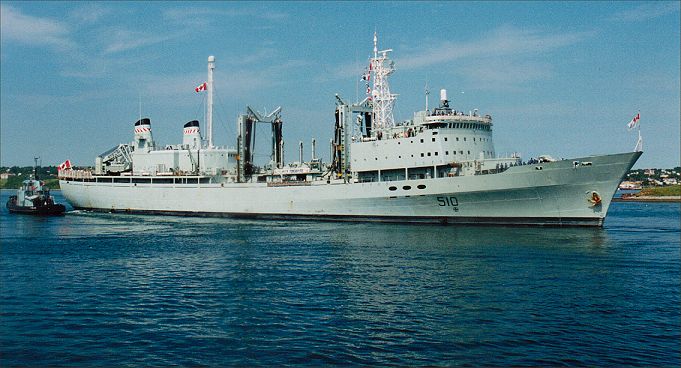 HMCS Preserver
The government has decided to replace these supply vessels with three new ships, each of which will be in the range of 28,000 tonnes, with the first to be delivered in 2012. The announced cost of the new buildings is $2.1 billion, a somewhat staggering amount for what will be support vessels, not fighting ships.
The need to replace Protecteur and Preserver goes without saying: they are both almost forty years old, having been launched in 1968 and 1969 respectively, an awfully long time to be plying the waters of our planet. The stresses placed upon any vessel working the high seas is considerable and only increases with the years; corrosion, structural integrity and aging machinery can create a hazardous environment for those who ship out aboard older vessels.
But the cost of the replacements for these two ships does make me wonder: Is $700 million for a single supply vessel not a tad high? On the world market, one can pick up a similar merchant ship for a lot less money – say $50-60 million. That’s off-the-shelf from a builder like Hyundai or Daewoo in South Korea (albeit with a waiting period for delivery of up to five years, owing to the huge backlog created in the commercial shipping industry).
Now there are a variety of reasons why a Korean vessel costs about $50 million and these new Canadian-built ones will be about $700 million. On the one hand, the Canadian shipyards will have to re-tool, hire and train new staff and essentially start from square one (they’re more attuned to refitting and repairing vessels than new construction). As well, military procurements normally require the work to be done at home, whether for national prestige, security requirements or job-creation scenarios. And, of course, there are the peculiar requirements of a naval vessel versus a commercial one, one meant to not only battle the sea but also a belligerent enemy. On the other hand, Korean shipyards are mass-production facilities geared to the requirements of the private sector that pay their workers less than their Canadian counterparts – base economics.
Still, I have to posit that perhaps Canada could have ordered some vessels from a reputable foreign yard, brought them to Canada and refitted them to our naval standards. It might have saved hundreds of million dollars, money that could have been used elsewhere in our cash-strapped armed forces.
Will it be worth it? Well if past experience has shown anything, just keep an eye on the cost overruns and delivery delays.
posted by Daniel Sekulich @ 12:11 AM
6 comments


6 Comments:
15.07.04daigege
longchamp handbags
ralph lauren
chanel handbags
chaussure louboutin
coach outlet online
nike blazer low
burberry sale
oakley sunglasses sale
longchamp pas cher
michael kors uk
soccer shoes
michael kors outlet
abercrombie outlet
coach factory outlet
air jordan
ed hardy clothing
nike air force
michael kors bag
oakley store
ed hardy
cheap oakleys
mcm outlet
oakley sunglasses
gucci
gucci outlet
christian louboutin outlet
true religion jeans
nike air max
cheap ray ban sunglasses
cheap jerseys
ed hardy
jordan shoes
prada outlet
hollister clothing store
ray ban glasses
20151031dongdong
ugg boots outlet
louis vuitton handbags
michael kors outlet
ralph lauren uk
mcm
canada goose uk
true religion jeans
air force 1
coach factorty outlet
snapbacks wholesale
christian louboutin outlet
michael kors outlet
kate spade handbags
ugg outlet online
nike trainers
cheap ugg boots
michael kors uk
kate spade outlet
micahel kors
nike air max 90
north face
jordan 3
michael kors
longchamp bags
air jordan 8
coach outlet
air jordan pas cher
coach outlet
cheap uggs on sale
cheap jordan shoes
adidas shoes
michael kors
michael kors outlet
polo ralph lauren
michael kors uk
michael kors handbags
michael kors outlet
christian louboutin uk
running shoes
nike tn
coach handbags outlet
true religion jeans sale
mlb jerseys
cheap jordan shoes
michael kors uk
michael kors outlet
coach outlet store
louis vuitton outlet store
lacoste pas cher
michael kors handbags wholesale
coach outlet online
michael kors outlet
true religion outlet
cheap ugg boots
michael kors handbags
rolex watches,rolex watches,swiss watches,watches for men,watches for women,omega watches,replica watches,rolex watches for sale,rolex replica,rolex watch,cartier watches,rolex submariner,fake rolex,rolex replica watches,replica rolex
oakley sunglasses
cheap ray ban sunglasses
longchamp handbags outlet
giuseppe zanotti outlet
1128minko
Lane Kiffin cheap nfl jerseys was apparently putting in some work for Nike Roshe Run FAU even before anyone really knew he was Nike Free Run a candidate for the job.
While there’s been nothing official yet from the school, all signs and reports nfl jerseys store are pointing to the Alabama offensive coordinator being named as the head Nike Air Max 90 coach at christian louboutin uk Florida Atlantic at some point in the not-too-distant future — specifically, at an expected press conference as early as Tuesday morning. Last week, even before reports christian louboutin shoes connecting louboutin outlet Kiffin to FAU first surfaced, NFL Jerseys Kiffin was reportedly looking to add a quarterback wholesale nfl jerseys with whom he’s Nike Air Max 2015 Shoes very familiar.
0http://www.prokr.net/2016/09/swimming-pools-maintenance-cleaning-companies-9.html
http://www.prokr.net/2016/09/swimming-pools-maintenance-cleaning-companies-8.html
http://www.prokr.net/2016/09/swimming-pools-maintenance-cleaning-companies-7.html
http://www.prokr.net/2016/09/swimming-pools-maintenance-cleaning-companies-6.html
http://www.prokr.net/2016/09/swimming-pools-maintenance-cleaning-companies-5.html
http://www.prokr.net/2016/09/swimming-pools-maintenance-cleaning-companies-4.html
http://www.prokr.net/2016/09/swimming-pools-maintenance-cleaning-companies-3.html
http://www.prokr.net/2016/09/swimming-pools-maintenance-cleaning-companies-2.html
http://www.prokr.net/2016/09/swimming-pools-maintenance-cleaning-companies.html
If I were the one having to write this content, all these readers would be disappointed. It’s a good thing you are the writer and you bring fresh ideas to us all. This is interesting. cheapjerseyswholesale
Post a Comment
<< Home